
“When a Cavity Isn’t Just a Cavity”
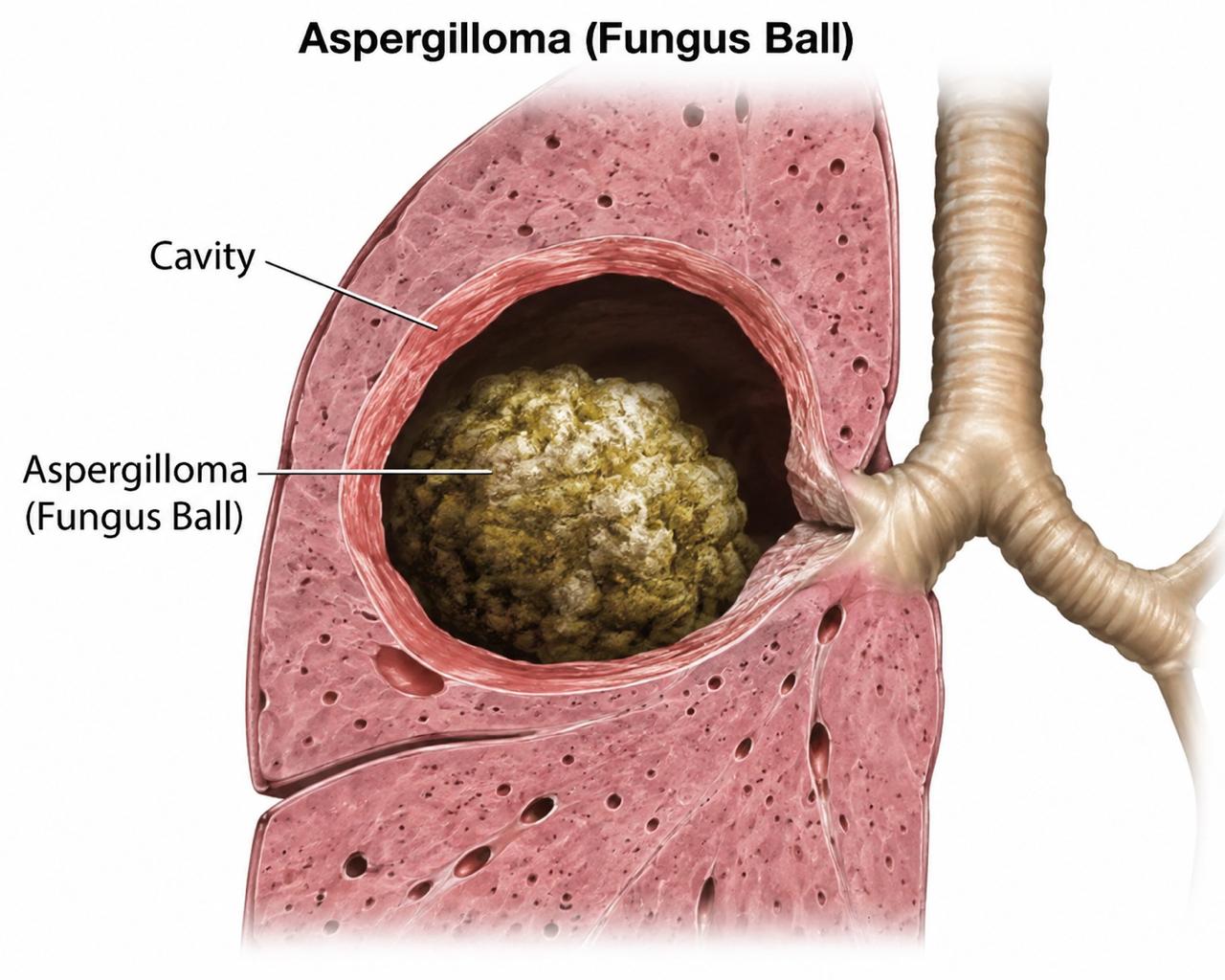
For most pulmonologists, the diagnosis of pulmonary aspergilloma is rarely the hard part. The harder question is when — or whether — to bring in a surgeon. Here’s how I think through that threshold.
“A Small Ball With Big Implications”
Simple vs. Complex: The Distinction That Drives Everything
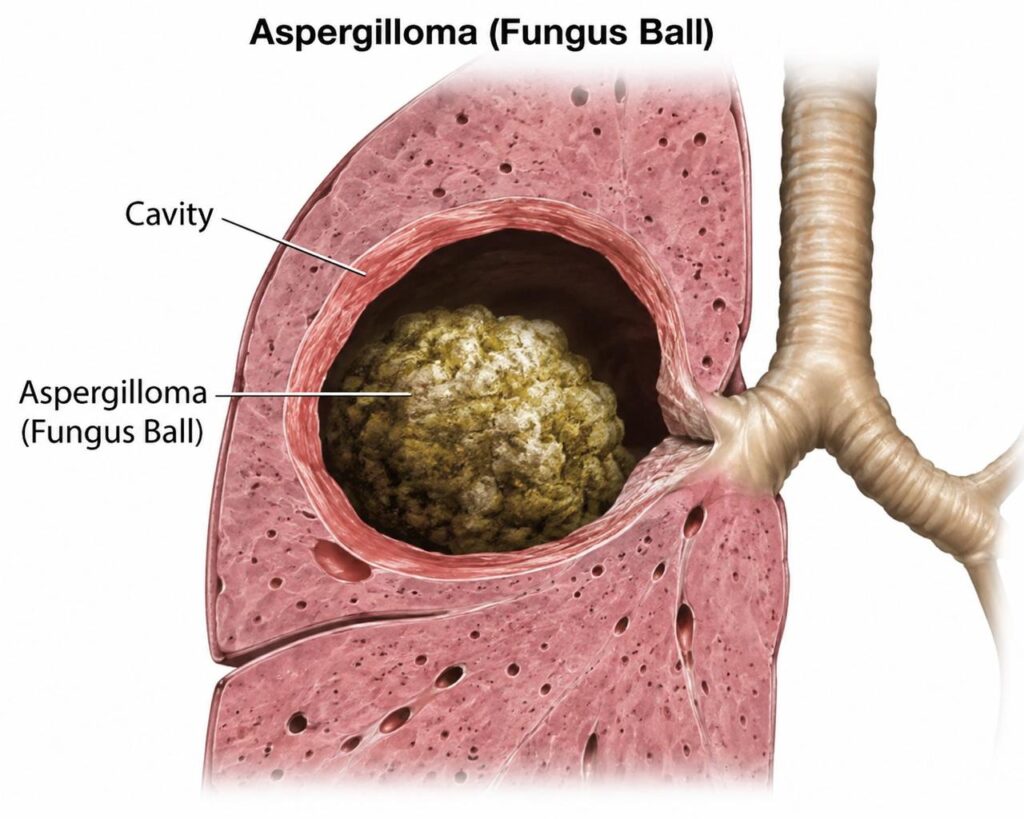
The Belcher-Plummer classification, now over six decades old, still holds up in daily practice.¹ Simple aspergilloma sits in a thin-walled cavity with normal surrounding lung and no pleural involvement. Complex aspergilloma develops in a thick-walled cavity within an already diseased lung — often post-tuberculous — frequently with pleural thickening and reduced pulmonary reserve.
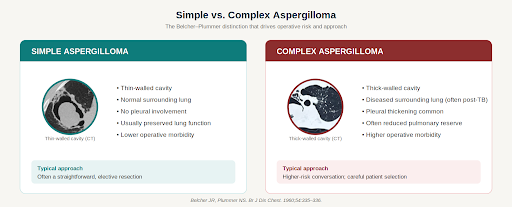
This isn’t an academic distinction. It’s the biggest driver of both operative risk and approach. A simple aspergilloma in a fit patient is often a straightforward resection. A complex aspergilloma in someone with limited lung function and dense adhesions is a different risk conversation entirely — complex cases carry meaningfully higher perioperative morbidity than simple ones.
“The classification tells you as much about the operation you’re planning as it does about the disease itself.”
When Surgery Earns Its Place
Medical therapy has a limited role once symptoms appear — there’s still no well-established medical alternative to surgery for a symptomatic simple aspergilloma.² Surgical referral is generally warranted for:
Asymptomatic, incidentally found simple aspergillomas in patients with adequate reserve are often reasonable to observe rather than operate on immediately.
Timing Changes the Risk Profile
Elective resection in a stable patient is a controlled operation. The same resection performed urgently after a significant bleed — in a patient who hasn’t been optimised — carries higher risk. Where the clinical picture allows it, referring before a bleeding episode forces the issue is usually the safer path.
“Refer Early. Operate Electively. Avoid the Emergency”
What Helps the First Consult Move Faster
- Recent CT chest — ideally within 4–6 weeks for anything symptomatic
- Pulmonary function tests— where available
- A clear symptom timeline — particularly any hemoptysis, however minor
- Relevant comorbidities — prior TB, immunosuppression, underlying lung disease
References
-
- Belcher JR, Plummer NS. Surgery in broncho-pulmonary aspergillosis. Br J Dis Chest. 1960;54:335–336.
- Surgical management of pulmonary aspergilloma—12 years’ experience from a tertiary care centre in India. Indian J Thorac Cardiovasc Surg. 2021.
- Ashok M, Tapias LF, Butala P, et al. Surgical treatment of pulmonary aspergilloma. Ann Thorac Surg. 2022.
“In pulmonary aspergilloma, early referral is often the best treatment we have.”